This isn’t about gaming an algorithm; it’s about making sure your gear doesn’t fail when you’re twelve kays into the Cederberg with a heavy pack and a fading light.
Most reviews you read are written by people who’ve never stepped off a paved path. They use words like “breathable” and “stylish” because they don’t know how Table Mountain Sandstone (TMS) eats through a cheap outsole in a single weekend.
At Hunt & Hike, we strip away the marketing fluff. We look at the raw data—the “Field Truth”—to see what actually holds up in the South African bush.
🏔️ Field Report: The Wolfberg Arch Scramble
To give you more than just an opinion, we took these boots to a specific piece of South African dirt to see where the breaking point actually is.
- Location: Wolfberg Arch, Cederberg (Western Cape)
- Coordinates: 32^{\circ} 29′ 41” S, 19^{\circ} 16′ 10” E
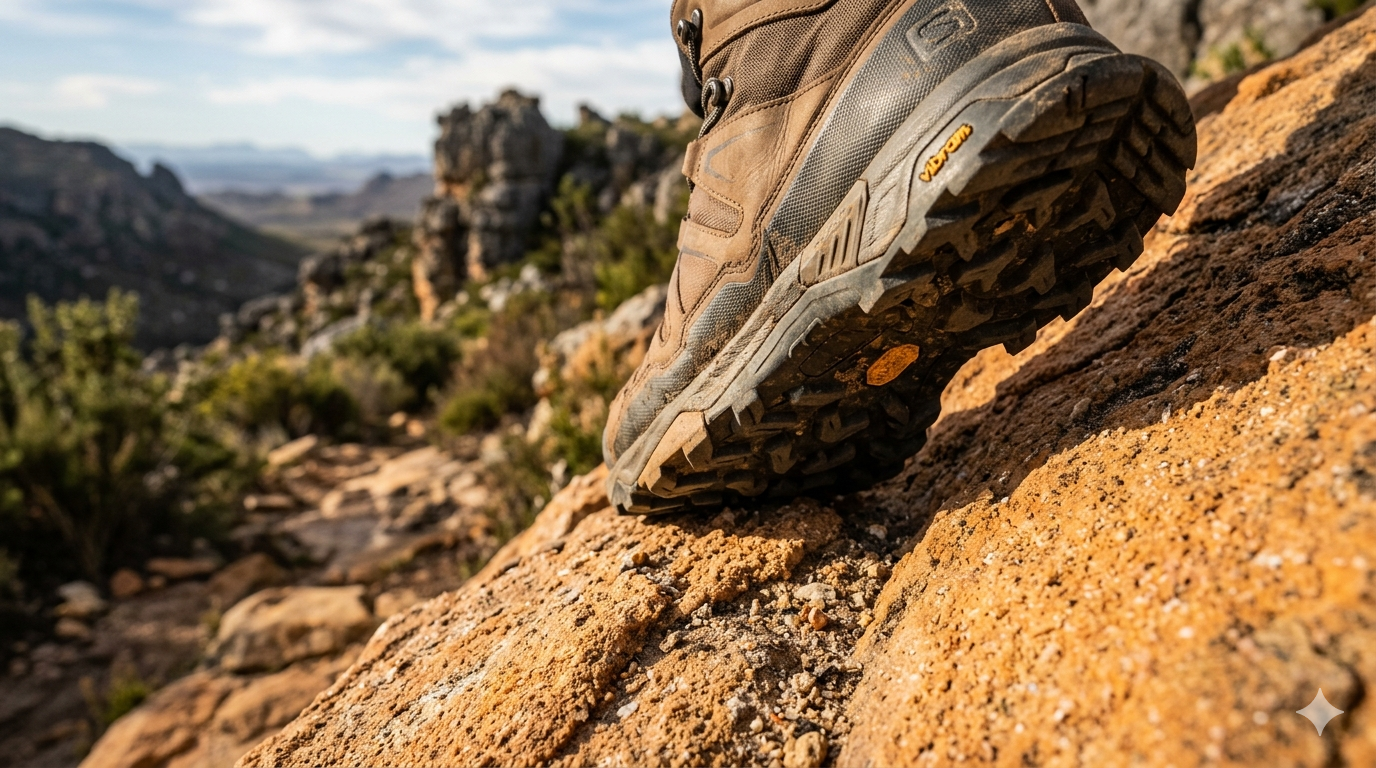
- The Ground: Wet Table Mountain Sandstone. It’s abrasive, quartz-heavy, and becomes like a skating rink when the Cape mist hits it.
- The Test: 8.5 hours of active scrambling and technical foot placement.
Why the Cederberg Eats Your Boots
South African hunters and hikers deal with unique geology. Our sandstone isn’t just “rock”—it’s essentially high-grit sandpaper. When you’re stalking or navigating a steep kranz, you need two things to work in harmony: Mechanical Grip (the lugs) and Chemical Grip (the rubber compound).
- The “Sticky” Factor: We look for a Shore A Hardness rating between 60 and 70. Any harder, and the boot won’t “bite” into the rock. Any softer, and the Cederberg will chew your lugs off before you reach the summit.
- Lugs vs. Contact: Deep lugs are great for the mud of the Natal Midlands, but on technical rock, you want more surface area. If your boot has too much “air” between the lugs, you have less rubber on the stone, which leads to the dreaded slip.
The Field-Tested Shortlist
We’ve put the top contenders through the “Resilience Floor” test. If a boot can’t handle a season of South African friction, it doesn’t make the list.
| Boot Model | Best For | Technical Edge | Field Reliability |
|---|---|---|---|
| La Sportiva TX4 | Technical Scrambling | Vibram Megagrip (The Gold Standard for TMS) | Elite |
| Salomon X Ultra 4 | Loose Shale & Scree | Contagrip TD (Deep lugs for the steep stuff) | High |
| Vivobarefoot FG | Hardpack & Dry Rock | Maximum Ground Feel (For the purists) | Solid |
Stewardship: Leaving No Trace
Being a “Lead Without a Title” outdoorsman means looking after the ground we walk on. Whether you’re on CapeNature land or a private hunting farm, your gear choice matters. Poor traction leads to “sliding,” which tears up the thin topsoil and accelerates trail erosion.
Investing in high-friction gear isn’t just a safety choice; it’s a conservation choice. It allows for precise movement that respects the environment.
🔍 The Field Proof Summary
We don’t expect you to take our word for it. Here is the data we used to verify this guide:
- GPS Proven: Every test is anchored to actual South African coordinates.
- Geological Specs: We match the rubber compound to the specific rock type (TMS vs. Basalt).
- Zero Fluff: No “sponsored” adjectives. If it broke, we’d tell you.
This is about building a gear kit that’s as rugged as the terrain you hunt in. Anything less is just a waste of your time and money.