
The “Waterproof” Lie: Gear That Actually Survives a Cape Winter Hike
You drop R5,000 on a top-tier, imported “waterproof” jacket. You pack your kit and head up into the Outeniqua mountains in July. Two hours into a driving Cape winter storm, you are shivering, clammy, and soaked to the bone. Did the jacket leak? Probably not. You just fell victim to the biggest lie in the outdoor gear industry.
Staying dry in the bush isn’t about throwing a tarp over your body to block the rain. It is about moisture management. You don’t just get wet from the sky; you get wet from your own sweat when your expensive jacket forgets how to breathe.
Here is the hard truth about gear failure in the South African winter, and how to actually stay warm when the weather turns.
The DWR Death by Fynbos (“Wetting Out”)
To understand why your jacket failed, you need to understand how it’s built. Most high-end rain jackets rely on a breathable membrane (like Gore-Tex) protected by a Durable Water Repellent (DWR) factory coating. That DWR is what makes the water bead up and roll off the fabric.
But the designers sitting in European labs aren’t testing their gear against South African fynbos.
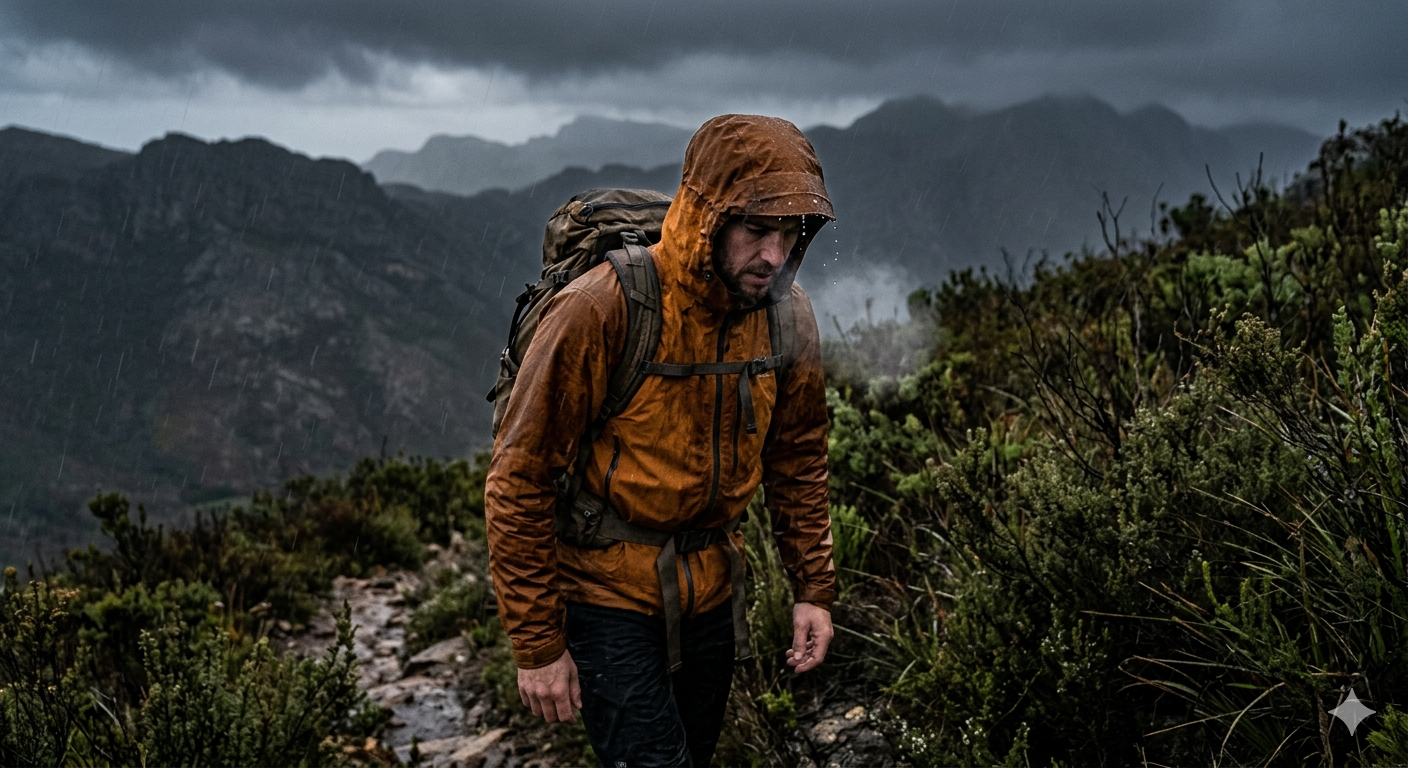
Pushing through dense, abrasive brush or scraping your shoulders against Cederberg sandstone strips that chemical DWR coating right off the face fabric. Once the DWR is compromised, the outer layer of the jacket absorbs water like a sponge. It feels heavy, cold, and dark. In the outdoor industry, this is called “wetting out.”
The Inside Threat: Drowning in Your Own Sweat
Wetting out isn’t just uncomfortable; it physically breaks the mechanics of your jacket.
When the outside of your jacket is saturated with a solid sheet of cold rainwater, the highly advertised “breathable” membrane underneath it completely stops working. Your body heat and sweat can no longer pass through the fabric.
Now, factor in the exertion. If you are hiking a steep incline or hauling a heavy pack up a kloof, you are generating massive amounts of heat. Because that sweat has nowhere to go, it hits the cold inside layer of your wetted-out jacket and condenses. Within an hour, you are soaking wet from the inside out.
Mechanical Venting: The Non-Negotiable Feature
This is the single most important lesson for active winter hiking: Mechanical venting beats breathable fabrics every single time.
A jacket with a mediocre waterproof rating but massive “pit zips” (underarm vents) is infinitely better for an active hiker than a R10,000 expedition shell with no vents. You have to actively manage your body heat. You open the zips before you hit the incline, and before you start sweating. If you wait until you feel clammy inside your shell, you have already lost the thermal battle.
The South African Winter Layering Strategy
To survive a wet winter hike, you need a system, not just a jacket.
- Base Layer (Moisture Movement): The golden rule of the outdoors: Cotton kills. A cotton t-shirt acts like a wet towel, holding cold sweat against your skin and rapidly dropping your core temperature the moment you stop moving. Wear Merino wool or specialized synthetics designed to wick moisture away from your body.
- Mid Layer (Insulation): A highly breathable fleece is your workhorse. Fleece is entirely synthetic, meaning it doesn’t hold much water and retains its ability to trap body heat even if it gets slightly damp from sweat. Leave the bulky, expensive down jackets for the camp; down feathers clump together when wet and offer zero insulation on a rainy trail.
- Outer Layer (The Shield): This is your hardshell. Its only job is to block the wind and the driving rain.
Redefining “Dry”
If you are out in a massive Cape winter storm, pushing through wet fynbos for six hours, you are going to get a little damp no matter what you wear.
The goal isn’t to be perfectly, bone-dry—that is a marketing myth. The goal is to manage your microclimate, stay warm, and avoid hypothermia. Manage your layers, vent your heat early, and never trust your life to a piece of gear just because the tag says “waterproof.”


